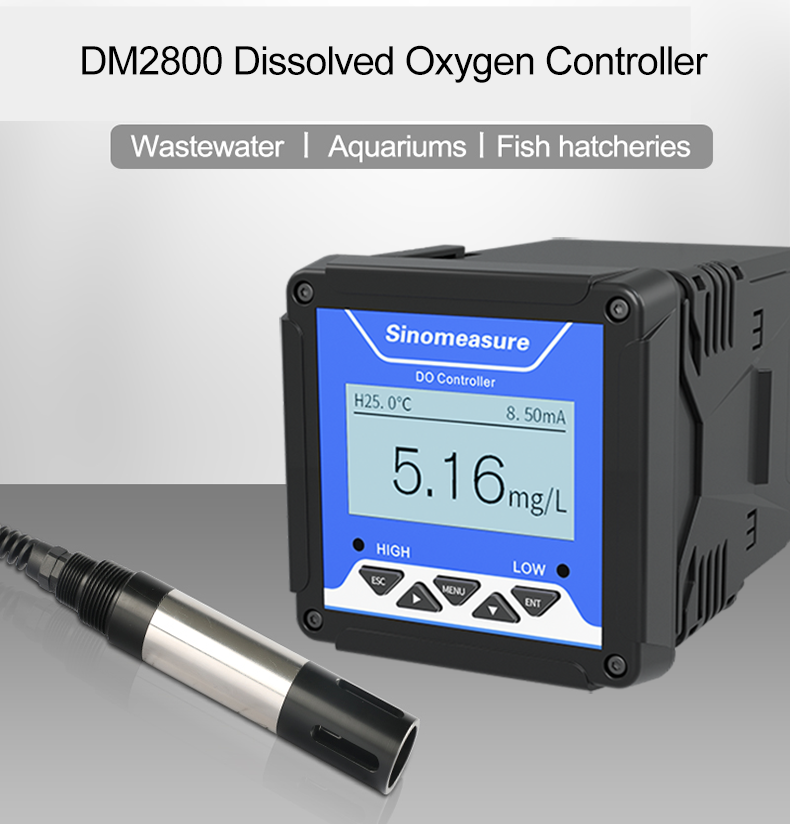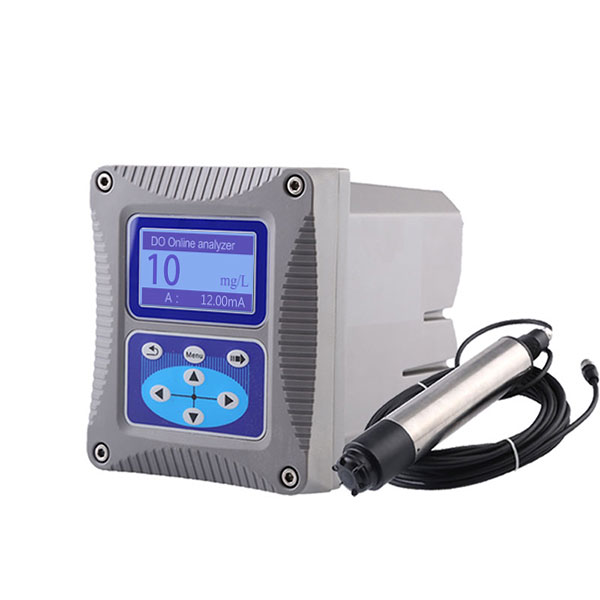

DM2800 Dissolved Oxygen Controller, DO Transmitter in Industrial/Environmental Processing


Introduction
The DM2800 economic dissolved oxygen controller employs a polarographic measurement principle in which dissolved oxygen diffuses through a membrane into the sensor, where an electrochemical reaction generates a signal proportional to oxygen concentration.
This design enables accurate tracking of DO, percent saturation, and oxygen partial pressure, with the output presented on a liquid crystal display alongside medium temperature values.
The analyzer supports 4–20 mA analog output, relay alarms, and RS485 digital communication (MODBUS-RTU), enabling integration with control systems for automated monitoring and process control. The operational reliability across varying solution conditions, including temperature, pressure, and salinity, makes the DM2800 dissolved oxygen controllers suitable for a broad range of industrial and environmental applications.
Working procedure
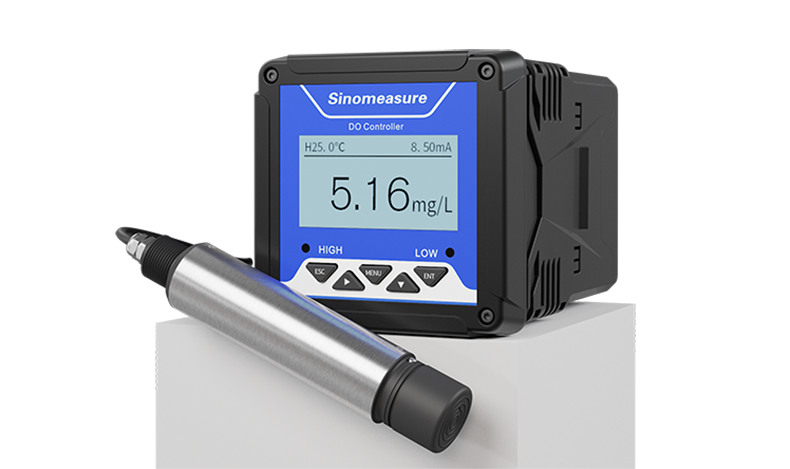
The DM2800 dissolved controller begins the DO measurement based on this straightforward routine:
1. Membrane diffusion of oxygen
Dissolved oxygen molecules in the aqueous solution diffuse through the selective membrane covering the sensor. This membrane allows oxygen to pass while protecting the internal electrode system from direct exposure to liquids.
2. Electrochemical Conversion
Once inside, the oxygen participates in a polarographic reaction at the sensor’s electrodes. The oxygen reduction at the cathode and the corresponding reaction at the anode generate a measurable current. This current is proportional to the oxygen concentration present in the sample.
3. Signal Processing and Output
The dissolved oxygen analyzer converts the current into DO concentration and related metrics, including saturation, oxygen partial pressure, through calibrated signal processing. These values are displayed on the LCD, while analog and digital output channels transmit the data to recorders, PLCs, or remote monitoring systems for process control or logging.
Key features
To ensure accurate, stable, and user-friendly dissolved oxygen measurement, the meter offers the following key features:
-
Membrane-type polarographic measurement: Uses a gas-permeable membrane to allow dissolved oxygen diffusion for stable electrochemical detection.
-
Wide measuring range: Capable of monitoring DO concentration, saturation, and oxygen partial pressure, accommodating typical environmental and industrial ranges.
-
High resolution: Fine resolution down to 0.01 mg/L for precise dissolved oxygen detection.
-
Multi-output interfaces: Includes 4–20 mA analog output, relay control outputs, and RS485 digital communication with standard MODBUS-RTU protocol for system integration.
-
Temperature sensing and compensation: Integrated NTC10K/PT1000 temperature input supports temperature compensation, improving measurement accuracy across varying conditions.
-
Visual display: Clear LCD presents real-time DO, saturation, and temperature, facilitating onsite monitoring without external devices.
-
Alarm functionality: Relay outputs can be configured for upper/lower limit alarms to support process safety and control functions.
Specification
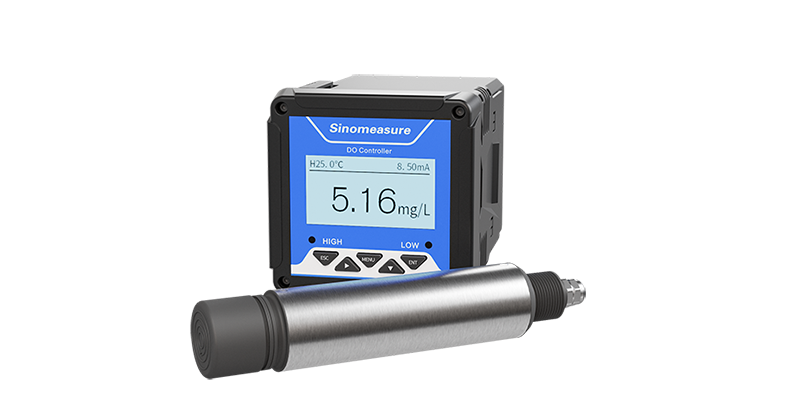
| Product | Dissolved Oxygen meter(Membrane type) |
| Model | DM2800 |
| Measure range | 0-20mg/L,0-200%,0-400hPa |
| Resolution | 0.01mg/L,0.1%,1hPa |
| Accuracy | ±1.5%FS |
| Temperature Type | NTC 10k/PT1000 |
| Auto A/manual H | -10-60℃ Resolution;0.1℃ Correction |
| Correction accuracy | ±0.5℃ |
| Output Type 1 | 4-20mA output |
| Max loop resistance | 750Ω |
| Repeatblitiy | ±0.5%FS |
| Output Type 2 | RS485 digital signal output |
| Communication protocol | Standard MODBUS-RTU(customizable) |
| Power supply | AC220V±10%50Hz/60Hz5W Max |
| Alarm relay | AC250V,3A |
Applications
The DM2800 Dissolved Oxygen Control measurement is well-suited for a variety of industrial and environmental monitoring applications where understanding and controlling oxygen levels is critical:
-
Wastewater Treatment: Monitoring DO levels in biological treatment tanks to optimize aeration and treatment efficiency.
-
Environmental Water Quality Monitoring: Continuous measurement of oxygen in rivers, lakes, or reservoirs as an indicator of ecological health.
-
Industrial Water Processes: Oxygen monitoring in cooling water, effluent streams, and process liquids to prevent corrosion and scaling, and maintain process consistency.
-
Aquaculture and Fisheries: Ensuring adequate dissolved oxygen levels to support aquatic organism health and growth.
-
Drinking Water Systems: Tracking oxygen content to support corrosion control and water quality assurance.
-
Scientific and Research Settings: Real-time DO measurement to support experimental monitoring and environmental assessments.