




What is a TDS meter and how does it work?
Water is often called the “universal solvent” because it absorbs impurities more easily than almost any other liquid. Even crystal-clear water can carry a significant load of invisible minerals, salts, and metals. Whether you are maintaining a hydroponic garden, managing an industrial boiler, or simply ensuring your family’s drinking water is safe, you cannot manage what you cannot measure.
Entering the TDS meter is the first line of defense in water quality diagnostics. But what exactly is this device telling you, and how does it translate invisible particles into a digital number? Just follow this post to get the final answer!
Table of Contents:
3. The wide applications of the TDS meter
What is a TDS meter?
A Total Dissolved Solids (TDS) meter is a handheld digital device used to measure the combined content of all organic and inorganic substances contained in a liquid.
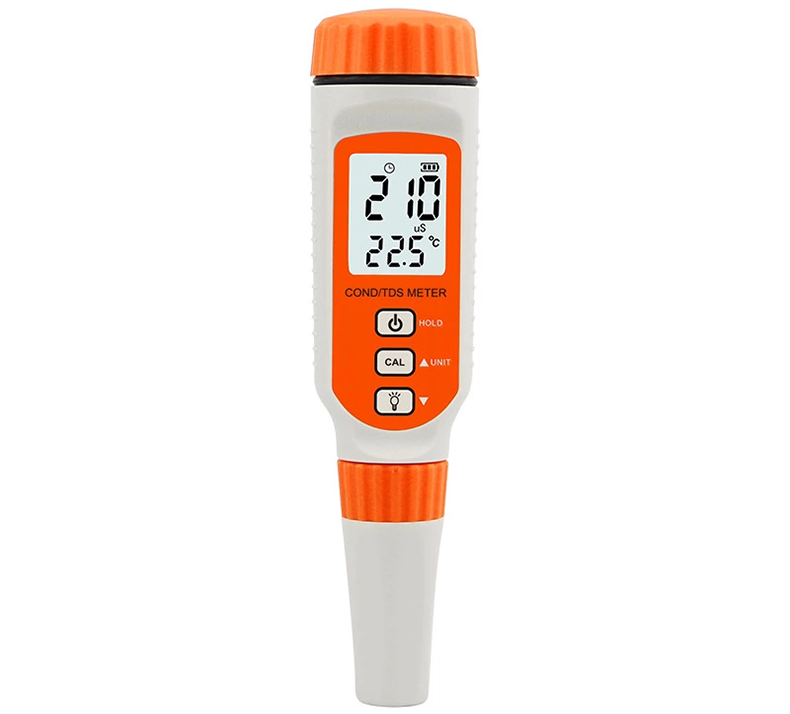
To understand the tool, you need to understand TDS first. Total Dissolved Solids refer to any minerals, salts, metals, cations, or anions dissolved in water, which typically include:
-
Essential minerals: Calcium, Magnesium, and Potassium.
-
Inorganic salts: Sodium, Chlorides, and Sulfates.
-
Potential contaminants: Lead, Arsenic, and Nitrates from agricultural runoff.
It is crucial to note that a TDS meter measures dissolved solids, not suspended solids. It won’t detect floating algae or mud (which relates to turbidity), but it will detect the invisible load that affects water hardness, taste, and corrosiveness.
A higher TDS reading (measured in ppm or parts per million) generally indicates “harder” water with a higher concentration of these foreign substances.
How does a TDS meter work?
Provided that we have figured out the TDS and the TDS meter, it’s time to explore how a TDS meter works. To understand a TDS meter’s working principle, you first need to understand a basic rule of physics: Pure water is actually an insulator. It does not conduct electricity well.
However, when minerals and salts (like calcium, magnesium, and sodium) dissolve in water, they turn into electrically charged particles called ions. These ions act like a bridge, allowing electricity to flow.
While displaying a count of particles, the TDS meter does not actually “count” them physically. Functionally, it is an electrical conductivity meter. The TDS meter exploits this physical property using a four-step process:
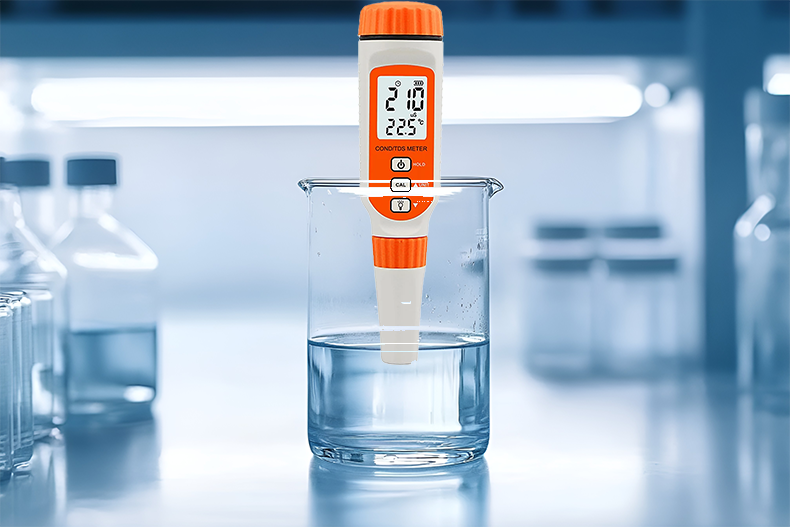
Step 1: Emission
When you remove the cap and submerge the TDS meter, you will notice two metal probes (pins) at the tip. The device’s battery sends a tiny, harmless electrical pulse to one of these pins, waiting to see if it can travel.
Step 2: Conduction
The electricity tries to “jump” from one pin to the other through the water.
In pure water, if there are no dissolved solids (no ions), the electricity cannot cross the gap. Hence, the circuit remains broken.
In tap water, the dissolved salts and minerals carry the electrical charge from the first pin to the second.
Step 3: Measurement
The meter measures how easily the current reaches the second pin. This measurement is called electrical conductivity (EC).
-
High Conductivity = Many ions (lots of dissolved solids).
-
Low Conductivity = Few ions (very pure water).
Step 4: Calculation
The meter’s internal microchip takes that raw conductivity data and applies a mathematical conversion factor. It translates the electrical signal into a readable number, usually displaying the result in PPM (Parts Per Million).
Note that since the meter is actually measuring conductivity, it works best on inorganic solids (salts/minerals); however, it cannot easily detect organic contaminants like motor oil, gasoline, or pesticides, as these do not conduct electricity well.
The wide applications of the TDS meter
For professionals and hobbyists alike, the TDS meter is an essential diagnostic tool. Here is how it works in various industries:
1. Drinking Water & Filtration Analysis
TDS meters are widely used in drinking water and filtration analysis, which is the only way to quantitatively verify the efficiency of a Reverse Osmosis (RO) system.
Typically, an RO membrane should reject 90–99% of TDS, so if your tap water is 200 ppm, your RO water should be near 20 ppm or lower.
If the TDS level of the filtered water starts creeping up, it is a definitive signal that the membrane has degraded and needs replacement.
2. Hydroponics and Aquaponics
In soilless gardening, water is the delivery system for nutrition, and a TDS meter acts as the “fuel gauge” for the plants, which measures the strength of the nutrient solution. Both the TDS value and the pH value are significant for hydroponics.
Low readings provided by the TDS meter mean the plants are starving, while excessively high readings warn of potential “nutrient burn” or dehydration.
3. Aquariums and Aquaculture
Aquatic life is highly sensitive to osmotic pressure, which you can understand as the balance of salts between their cells and the surrounding water.
When the TDS meter is deployed in fresh water, its accurate reading of the low TDS matters much in the breeding industry, like Discus or Crystal Red Shrimp.
For reef tanks, aquarists use TDS meters to ensure their source water is 0 ppm before mixing expensive marine salts, preventing algae blooms caused by tap water impurities like silicates and phosphates.
4. Industrial Boilers and Cooling Towers
In industrial settings, high TDS is a precursor to scale buildup (limescale). Scale acts as an insulator in pipes and boilers, drastically reducing heating efficiency and increasing energy costs. Regular TDS monitoring allows engineers to determine exactly when to “blow down” (drain) the system to prevent equipment failure.
5. Swimming Pools and Spas
As water evaporates, pure water is left behind, but salts remain. Over time, TDS levels concentrate. When levels exceed 2,000 ppm, the water becomes “tired”, and the chemicals like chlorine lose their effectiveness, and the water may taste salty or irritate the skin.
A quick dip of a TDS meter indicates when it’s time to drain and refill, making it indispensable in swimming pool and spa scenarios.
Conclusion
TDS is of vital importance because it influences various scenarios from daily life to industry, for example, the TDS-filtrated water for window cleaning is much more advanced than the normal cleaning, since the water filtered by the TDS toolkit is cleaner and impurity-free.
On top of this case, the TDS meter can be seen in many other cases. You can explore its wide applications by reading this post!
Post time: Dec-04-2025